
Outreach
Here, we collect some outreach activities, have fun and feel free to distribute.
ECAP In the Media
- Weltraumforschung in Erlangen: Das neue ECAP-Forschungsgebäude | Franken Fernsehen (30.11.2022)
- Erlangen Centre for Astroparticle Physics – Architektouren 2023 – Bayerische Architektenkammer (24.06.2023)
ECAP Laboratory Exhibits
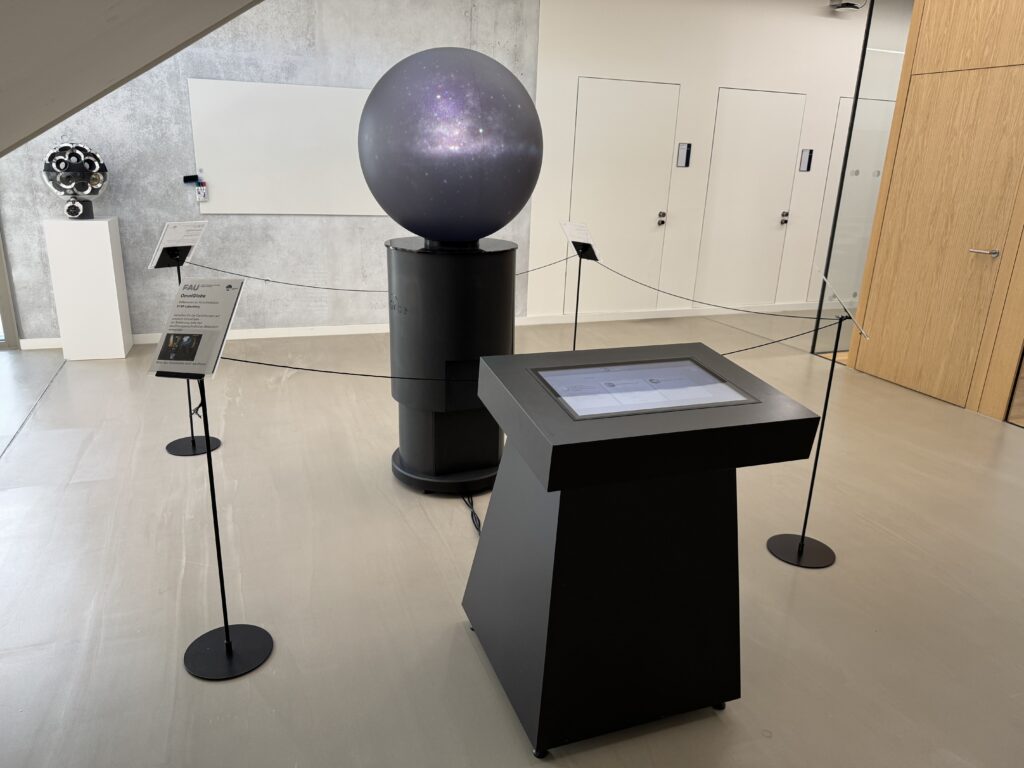
OmniGlobe – first floor communication area
The OmniGlobe presents ECAP-related science on a spheric surface, allowing to display skymaps or animated scientific results on 2 square metres.
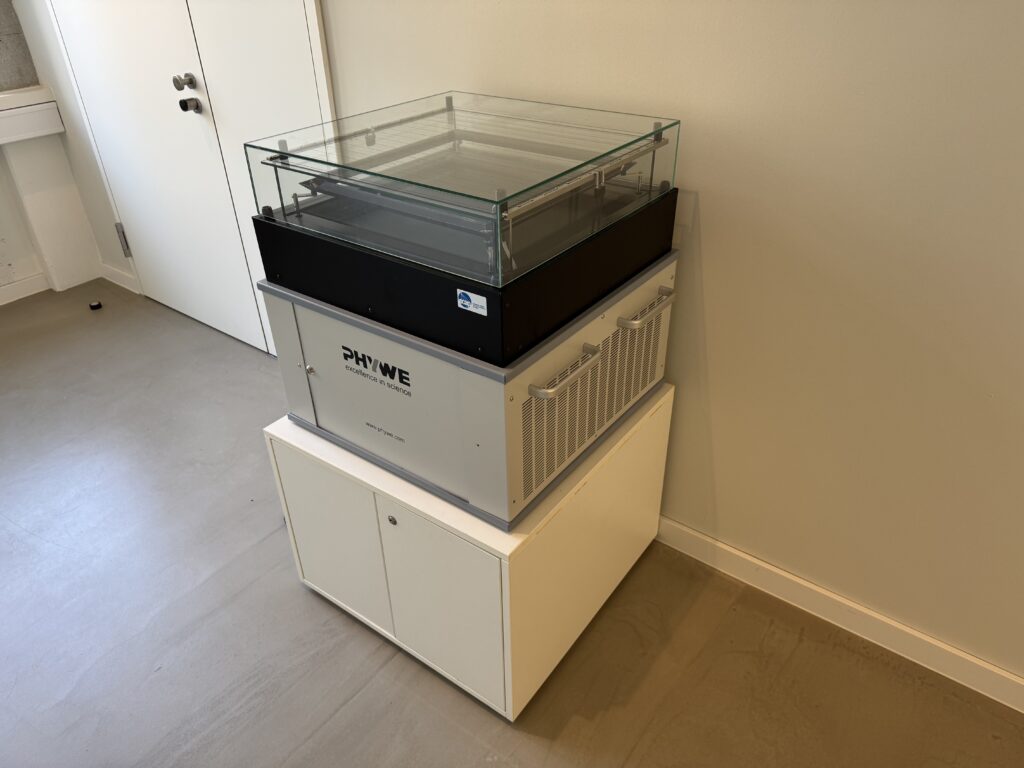
Cloud Chamber – first floor corridor North/West
The cloud chamber is used to observe particle traces from ambient radioactivity and cosmic radiation. A special property of this radiation is used to make the traces visible: its ionisation capacity.
The cloud chamber contains alcohol vapour. When ionising radiation hits a vapour molecule, electrons are knocked out along the particle’s trajectory to form ions. The ions act as condensation nuclei and form droplets in the supersaturated vapor layer just above the cold base plate by attaching further molecules, which can be seen as a bright trace under suitable lighting.
The principle is therefore very similar to the formation of condensation trails by soot particles in aircraft exhausts!
ANTARES and KM3NeT Optical Modules
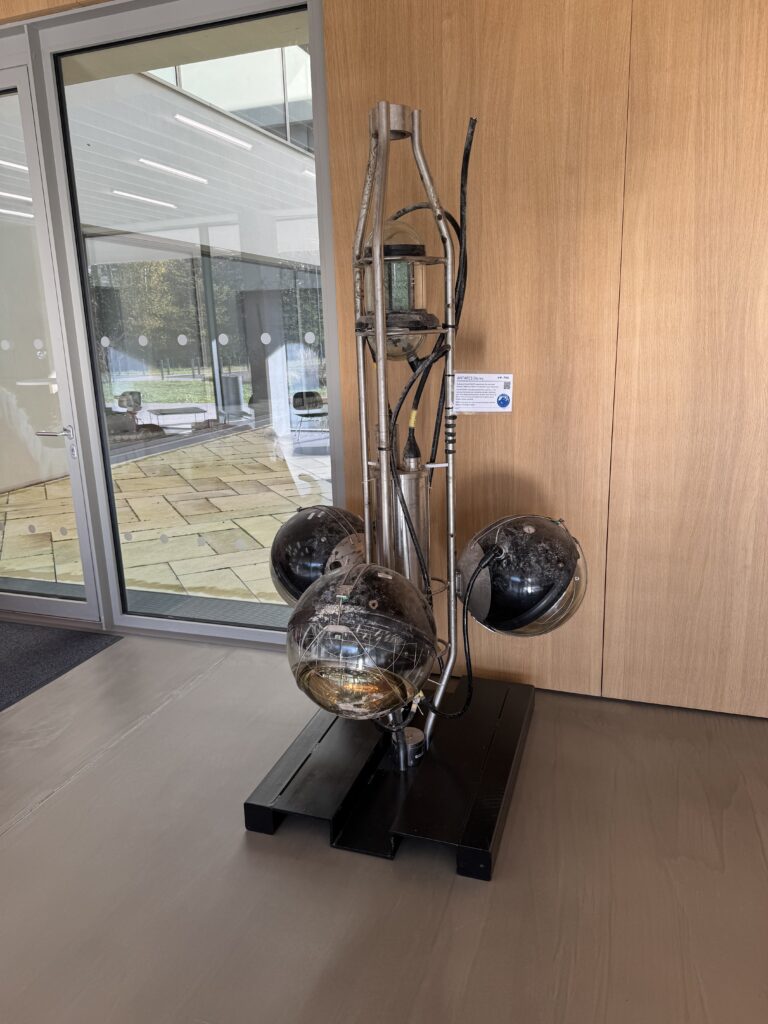
ANTARES Storey – foyer
An actual storey of the ANTARES detector, operated in the Mediterranean deep sea for over ten years.
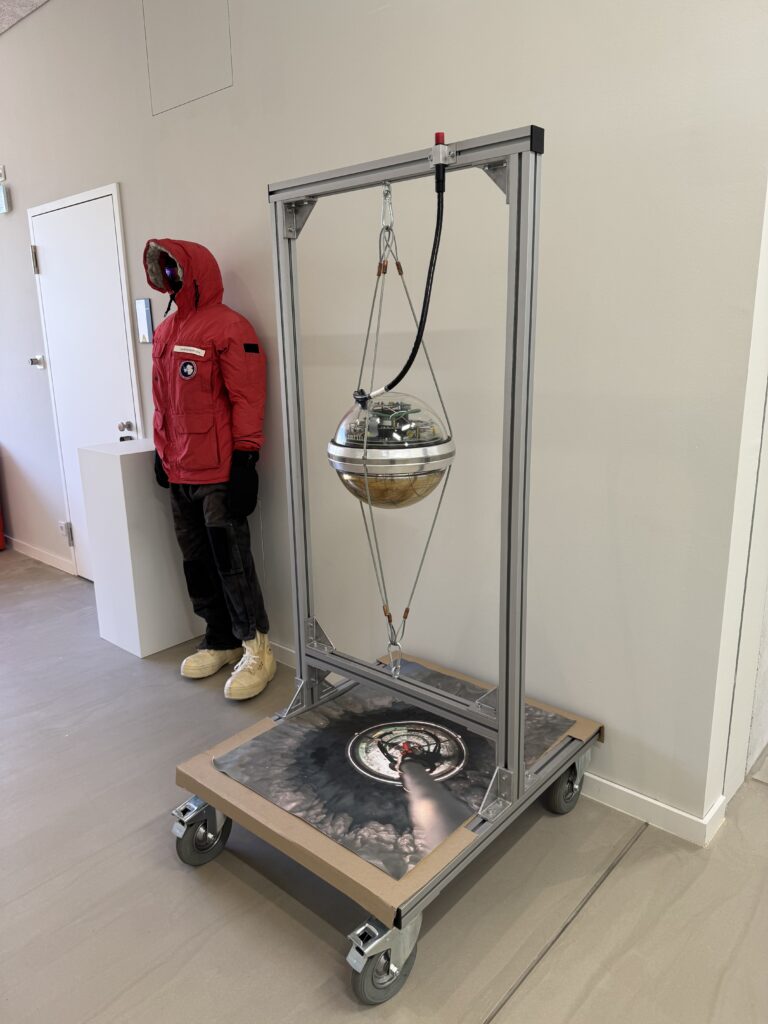
IceCube Optical Module – first floor South-western corridor
One IceCube optical module together with the cold weather gear to survive near the geographic South Pole is displayed at ECAP Laboratory as well.
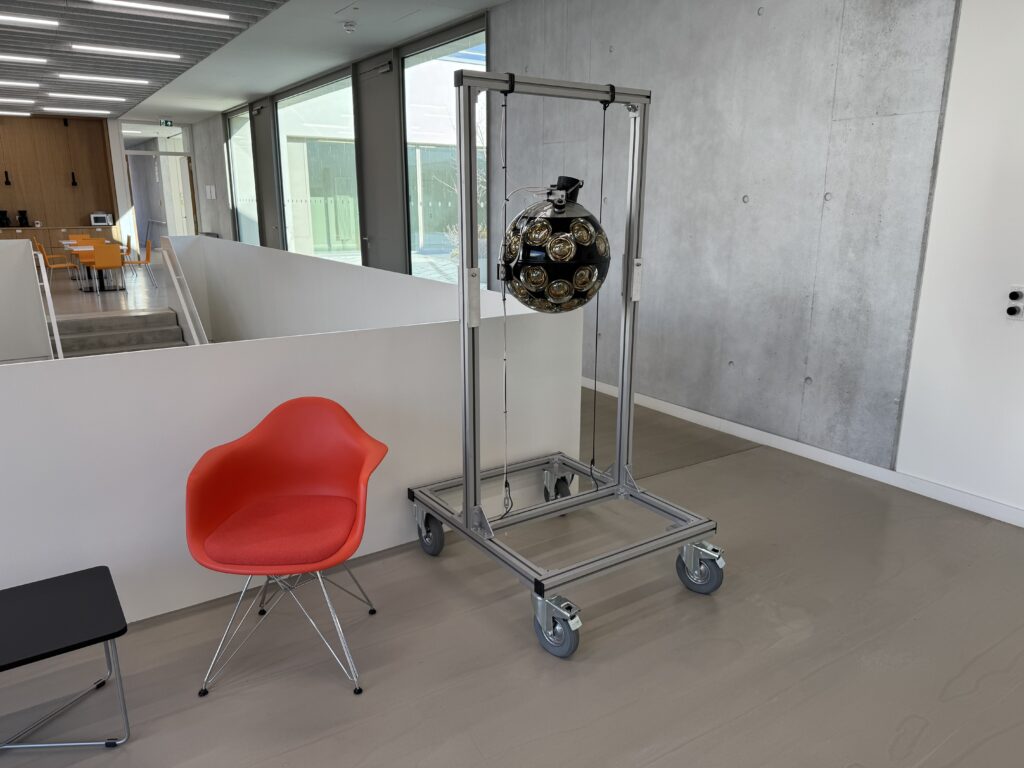
KM3NeT Optical Module – second floor communication area
One prototype of the KM3NeT optical modules, the multi-facetted eyes of the neutrino experiment. The optical sensors of the KM3NeT telescope, each with 31 photomultiplier tubes, are installed in the Mediterranean Sea.
CTA Models
MST Model – foyer
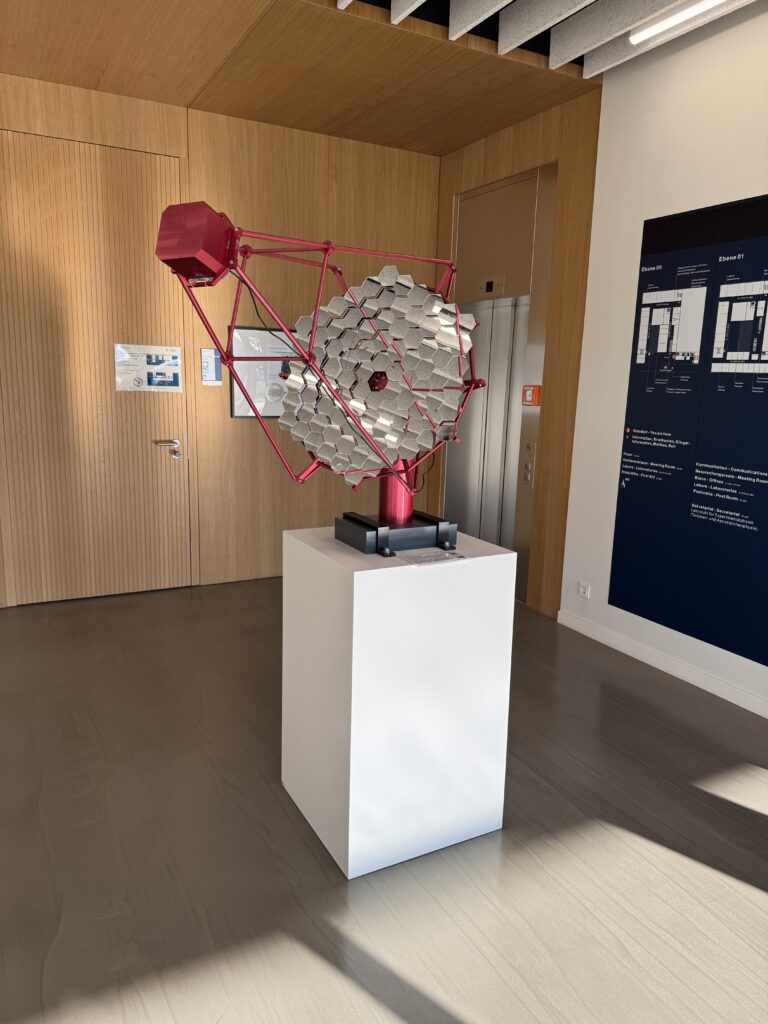
SST Camera – first floor corridor South/West

The camera for the CTA’s SSTs is based on the CHEC-S prototype. The SST camera contains 2048 SiPM pixels, each of which is triggered and digitisedusing gigasampledigitisation electronics based on TARGET ASICs. The camera offers a field of view of 8.8° and will be installed on a double mirror telescope. CTA will install 37 of these SSTs at the southern site in Chile in the first construction phase.
ECAP Laboratory Art – Lichtgewicht
Outside of research, we usually interpret light as an element without mass or gravity. In the installation ‘Lightweight’ for the courtyard of the ECAP Laboratory, however, we attribute precisely these properties to sunlight: it becomes visually tangible and takes on a light weight, a luminous body.
During the day, an oversized scale absorbs solar energy on one side using solar cells and stores it in a battery. The potential, i.e. the virtual weight, thus increases on the light sphere side of the scale, which slowly moves downwards. At nightfall, the light sphere is at the bottom; the stored energy is now released back into the environment in the form of radiant light energy. As the energy potential decreases, the light body slowly moves back up, and its bright rays gradually fade as darkness increases.
What is the weight of light?

ECAP Laboratory Wall Pictures
Here a collection of the pictures hanging in the corridors of the ECAP Laboratory:
The high-energy sky
Gamma-ray sky above 1 GeV as measured with NASA’s Fermi-LAT from 2008-2020, containing more than 7.5 Mio. events.
Gamma-ray sky above 1 GeV in galactic coordinates (Pass 8, PSF3 event class, 105 zenith angle) integrated for 12 years (Aug 4th 2008-2020) as measured with the Fermi Large Area Telescope (LAT).
This map contains 7.464.664 gamma ray events. Each pixel of this map covers 0.1° on the sky smoothed with a 0.25° FWHM gaussian. The map is logarithmically scaled (from 3 x 10⁻⁷ cm-2s-1sr-1 to 1 x 10⁻³ cm-2s-1sr-1) and presented in a Hammer-Aitoff projection.
Credits: Fermi-LAT collaboration and NASA
The violent centre of the Milky Way
Multi-wavelength picture of the inner 246 light years of the Centre of our Galaxy assembled from observations with NASA’s Great Observatories: Hubble space telescope (yellow), the Spitzer Space Telescope (red) and the Chandra X-ray observatory (blue and violet). The center of the galaxy (Sgr A*) is located within the bright white region to the right of and just below the middle.
Multi-wavelength picture of the inner 246 light-years (roughly the size of the full moon) of the centre of our Galaxy assembled from NASA’s Great Observatories – the Hubble Space Telescope (yellow, near-infrared, Paschen-Alpha), the Spitzer Space Telescope (red, infrared 3.6\mum, 5.8 \mum, 8 \mum), and the Chandra X-ray Observatory (blue and violett, X-ray, 1-8 keV). Observations using infrared and X-ray light to see through the obscuring dust and reveal the intense activity near the galactic core. The center of the galaxy (Sgr A*) is located within the bright white region to the right of and just below the middle. Yellow represent regions where stars are born, red indicate dust clouds glowing from radiation and winds from stars, blue shows gas heated to millions of degrees by stellar explosions. The bright blue region on the left side is emission from a star system (X-ray binary 1E 1743.1-2843) containing a neutron star or a black hole.
Credits: NASA, ESA
Four famous nebulae
These four nebulae are star-forming clouds of gas and dust observed with NASA’s infrared Spitzer Space telescope: Eagle Nebula (M16 – containing the pillars of creation), the Omega Nebula (M17), the Trifid Nebula (M20), and the Lagoon Nebula (M8). They are all part of the Milky Way Galaxy and are located in the Sagittarius Arm.
Credits: NASA
Fermi LAT ready to go
NASA’s Gamma-ray space telescope Fermi-LAT hangs suspended in its fairing, ready to be launched from Launch Pad 17-B at Cape Canaveral. Since June 2008 it is orbiting the Earth in low-earth orbit, observing high-energy gamma rays from the Universe”.
Credits: NASA/Kim Shiflett
IceCube Lab at the South Pole
Multiple curtains of aurora australis in the South Pole sky are visible beneath the band of the Milky Way. In the foreground stands the IceCube Lab (ICL) that serves as the central facility for the IceCube Neutrino Observatory. IceCube is using thousands of optical sensors embedded in the Antarctic ice to detect neutrinos from high-energy cosmic sources. This unique location at the geographic South Pole offers optimal conditions to study elusive subatomic particles and shed light on the most energetic processes in the Universe.
Credits: Martin Wolf, TU München / IceCube, NSF
Cherenkov Telescopes
Cherenkov telescopes are designed to detect the blue Cherenkov light emitted by particles traveling faster than the speed of light within Earth’s atmosphere. These particles are a byproduct of an atmospheric particle shower that is generated when high-energy particles, such as cosmic rays or gamma rays, interact with the Earth’s atmosphere.
Credits: DESY, Science Communication Lab