• Skip navigation
  • Skip to navigation
  • Skip to the bottom
Simulate organization breadcrumb open Simulate organization breadcrumb close
Erlangen Centre for Astroparticle Physics
  • FAUTo the central FAU website
  • Department of Physics
  • Dr. Karl Remeis Observatory

Erlangen Centre for Astroparticle Physics

Navigation Navigation close
  • Institute
    • Organisation and Code of Conduct
    • Research groups
      • Astronomy (Prof. Heber, Prof. Sasaki, Prof. Wilms)
      • Astroparticle Physics (Prof. Katz, Prof. van Eldik)
      • High-Energy Astrophysics (Prof. Funk)
      • Experimental Astroparticle Physics – Radiodetection of Neutrinos (Prof. Nelles)
      • Experimental Astroparticle Physics (Prof. Kopper)
      • Quantum Gravity (Prof. Thiemann, Prof. Giesel, Prof. Sahlmann)
      • Statistical Physics (Prof. Mecke)
    • ECAP Members
    • Vacancies
    • Thesis Topics
    • Infrastructure
    • Contact
    Portal Institute
  • Research
    • Publications
      • Articles and Proceedings
      • Theses
    • Astronomy and Astrophysics
    • Gamma-Ray Astronomy
    • Technology Transfer
    • Neutrino Astronomy
    • Neutrino Physics
    • Theory
      • Mathematical and Statistical Physics
      • Quantum Gravity
    • Cross-boundary Research Projects
    • Additional Research Areas
    Portal Research
  • Teaching
    • Current Lectures
    • School for Astroparticle Physics (ext.)
    • Erlanger SchülerForschungsZentrum (ext.)
    • Particle Physics Masterclasses (ext.)
    Portal Teaching
  • News and Events
    • News
    • Events
    • Seminar
    • ECAP-Shop
    • Outreach
    Portal News and Events
  • Thesis Topics
  1. Home
  2. Research
  3. Technology Transfer

Technology Transfer

In page navigation: Research
  • Gamma-Ray Astronomy
    • CTA
    • Fermi-LAT
    • H.E.S.S.
  • Publications
    • Articles and Proceedings
    • Theses
  • Neutrino Astronomy
    • ANTARES | KM3NeT
    • IceCube
    • Radio Detection
  • Astronomy and Astrophysics
  • Neutrino Physics
    • KM3NeT – ORCA
  • Theory
    • Mathematical and Statistical Physics
    • Quantum Gravity
      • Research in Loop Quantum Gravity
  • Technology Transfer
    • Medical Physics
    • Materials Testing
    • Laboratory Astrophysics
  • Additional Research Areas
    • Acoustic Particle Detection
    • Hadron Physics
    • EXO-200
    • nEXO
  • Cross-boundary Research Projects
    • ECAP AI Laboratory

Technology Transfer

From astroparticle physics to medical physics

Prof. Dr. Gisela Anton

Physikalisches Institut
Lehrstuhl für Experimentelle Astroteilchenphysik (Prof. Dr. Kopper)

Room: Room 02.034
Nikolaus-Fiebiger-Str. 2
91058 Erlangen
  • Phone number: +49 9131 85-70737
  • Email: gisela.anton@physik.uni-erlangen.de
  • Website: https://ecap.nat.fau.de/index.php/person/prof-anton/
Prof. Dr. Stefan Funk

Prof. Dr. Stefan Funk

Physikalisches Institut
Chair of Physics

Room: Room 02.036
Nikolaus-Fiebiger-Str. 2
91058 Erlangen
  • Phone number: +49 9131 85-70727
  • Email: s.funk@fau.de
  • Website: https://ecap.nat.fau.de/index.php/person/prof-dr-stefan-funk/

PD Dr. Thilo Michel

We employ techniques from astrophysics and astroparticle physics to enhance, develop and apply X-ray imaging methods and to investigate dosimetry applications.

Interferometric X-ray imaging

Conventional X-ray imaging operates on the principle that different materials absorb X-rays to varying degrees. Interferometric X-ray imaging is an extended imaging technique which leads besides the common attenuation image to two supplementary types of images: The differential phase-contrast and the dark-field image. By inserting microstructured gratings in a conventional X-ray imaging setup, the phaseshift imprinted on an X-ray wavefront by a sample, is analyzable. The differential phase-contrast image enhances differences between light elements, while the dark-field image is particularly sensitive to small angle scattering at tiny porous or fibrous structures, even on subpixel scale.
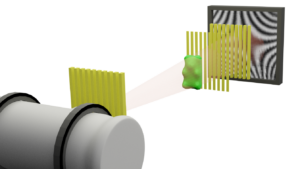
Grating interferometer
Figure 1: Sketch of a grating interferometer, from left to right: X-ray source, source grating, (gummy bear) sample, phase-grating, analyzer grating, X-ray detector. Credit: Veronika Ludwig.

In Figure 2 four gummy bears are shown prepared with different objects (wooden toothpick, metal needle, micrometre-sized powder) to visualize the advantages of each obtained image. The metal needle is best visible in the attenuation image. Wood and powder are clearly visible in the dark-field image. The differential phase image is sensitive to edges and shows finer details of the gummy bear shape and structure.
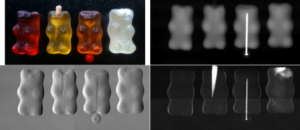
Figure 2: Photography of four gummy bears (top left) with respective attenuation image (top right), differential phase-contrast image (bottom left) and dark-field image (bottom right). Credit: Andrea Zang.

We contribute to the development of the imaging method to further improve the feasibility of interferometric X-ray imaging. Additionally, we evaluate the potential of X-ray phase-contrast and dark-field imaging for different fields of application like medical imaging, non-destructive testing and laboratory astrophysics.

Erlangen Centre for Astroparticle Physics (ECAP)
Friedrich-Alexander-Universität Erlangen-Nürnberg

Nikolaus-Fiebiger-Str. 2
91058 Erlangen
  • Contact
  • Imprint
  • Privacy
  • Accessibility
  • Internal
  • Facebook
  • Instagram
  • RSS Feed
Up