• Skip navigation
  • Skip to navigation
  • Skip to the bottom
Simulate organization breadcrumb open Simulate organization breadcrumb close
Erlangen Centre for Astroparticle Physics
  • FAUTo the central FAU website
  • Department of Physics
  • Dr. Karl Remeis Observatory

Erlangen Centre for Astroparticle Physics

Navigation Navigation close
  • Institute
    • Organisation and Code of Conduct
    • Research groups
      • Astronomy (Prof. Heber, Prof. Sasaki, Prof. Wilms)
      • Astroparticle Physics (Prof. Katz, Prof. van Eldik)
      • High-Energy Astrophysics (Prof. Funk)
      • Experimental Astroparticle Physics – Radiodetection of Neutrinos (Prof. Nelles)
      • Experimental Astroparticle Physics (Prof. Kopper)
      • Quantum Gravity (Prof. Thiemann, Prof. Giesel, Prof. Sahlmann)
      • Statistical Physics (Prof. Mecke)
    • ECAP Members
    • Vacancies
    • Thesis Topics
    • Infrastructure
    • Contact
    Portal Institute
  • Research
    • Publications
      • Articles and Proceedings
      • Theses
    • Astronomy and Astrophysics
    • Gamma-Ray Astronomy
    • Technology Transfer
    • Neutrino Astronomy
    • Neutrino Physics
    • Theory
      • Mathematical and Statistical Physics
      • Quantum Gravity
    • Cross-boundary Research Projects
    • Additional Research Areas
    Portal Research
  • Teaching
    • Current Lectures
    • School for Astroparticle Physics (ext.)
    • Erlanger SchülerForschungsZentrum (ext.)
    • Particle Physics Masterclasses (ext.)
    Portal Teaching
  • News and Events
    • News
    • Events
    • Seminar
    • ECAP-Shop
    • Outreach
    Portal News and Events
  • Thesis Topics
  1. Home
  2. Research
  3. Neutrino Astronomy
  4. The Pacific Ocean Neutrino Experiment

The Pacific Ocean Neutrino Experiment

In page navigation: Research
  • Gamma-Ray Astronomy
    • CTA
    • Fermi-LAT
    • H.E.S.S.
  • Publications
    • Articles and Proceedings
    • Theses
  • Neutrino Astronomy
    • ANTARES | KM3NeT
    • IceCube
    • Radio Detection
    • The Pacific Ocean Neutrino Experiment
  • Astronomy and Astrophysics
  • Neutrino Physics
    • KM3NeT – ORCA
  • Theory
    • Mathematical and Statistical Physics
    • Quantum Gravity
      • Research in Loop Quantum Gravity
  • Technology Transfer
    • Medical Physics
    • Materials Testing
    • Laboratory Astrophysics
  • Additional Research Areas
    • Acoustic Particle Detection
    • Hadron Physics
    • EXO-200
    • nEXO
  • Cross-boundary Research Projects
    • ECAP AI Laboratory

The Pacific Ocean Neutrino Experiment

Felix Henningsen

Dr. Felix Henningsen

Physikalisches Institut
Lehrstuhl für Experimentelle Astroteilchenphysik (Prof. Dr. Kopper)

Room: Room 01.040
  • Phone number: +49 9131 85-70738
  • Email: felix.henningsen@fau.de
Prof. Dr. Claudio Kopper

Prof. Dr. Claudio Kopper

Physikalisches Institut
Lehrstuhl für Experimentelle Astroteilchenphysik (Prof. Dr. Kopper)

Room: Room 01.038
Nikolaus-Fiebiger-Straße 2
91058 Erlangen
  • Phone number: +49 9131 85-70726
  • Email: claudio.kopper@fau.de
  • Website: https://ecap.nat.fau.de/index.php/institute/research-groups/particle-and-astroparticle-physics/

The Pacific Ocean Neutrino Experiment (P-ONE) is a novel detector initiative to build a large-volume neutrino array in the Pacific Ocean. In collaboration with Ocean Networks Canada, P-ONE aims to instrument more than a cubic kilometer of water using state-of-the-art sensor technologies to achieve unprecedented performance in detecting high-energy neutrinos and their sources.

ECAP is an important part of this project through the group of Prof. Claudio Kopper, developing a water tank measurement system for optical characterization of sensors, and software that collects and processes data which helps ensure the experiment operates accurately. This includes experimental laser systems and creating computer models of light and sound devices that measure water conditions and track the detector’s position in real time. ECAP is further a major contributor to building software for controlling and reading out the P-ONE detector and analyzing its data.
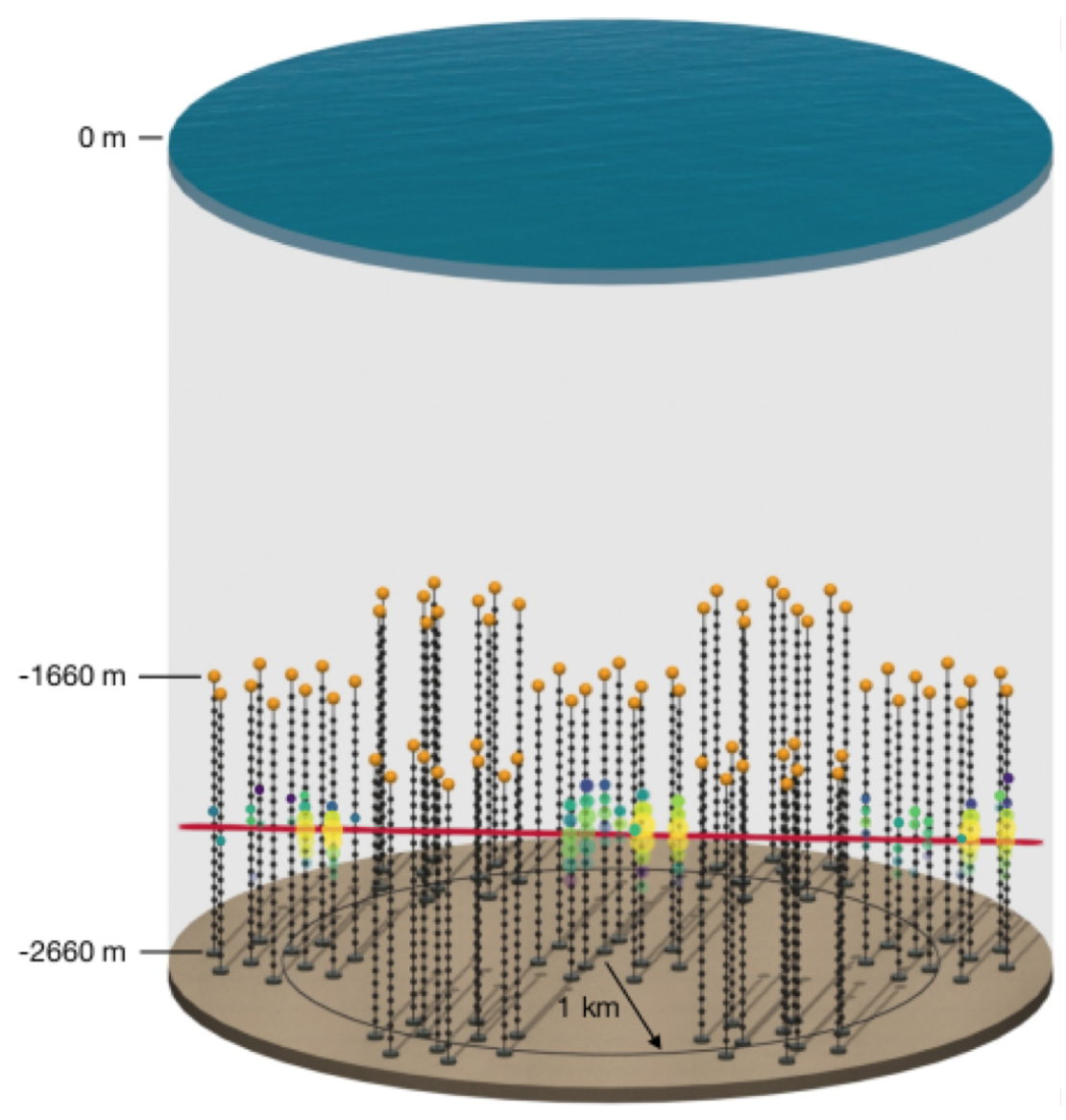
P-ONE detector concept
Concept design for the P-ONE detector with a high-energy muon (red line) passing horizontally through a cluster of detection lines. The sensor modules that detect Cherenkov light from the muon are shown in color. Credit: Agostini et al, The Pacific Ocean Neutrino Experiment. Nat Astron 4, 913–915 (2020) .
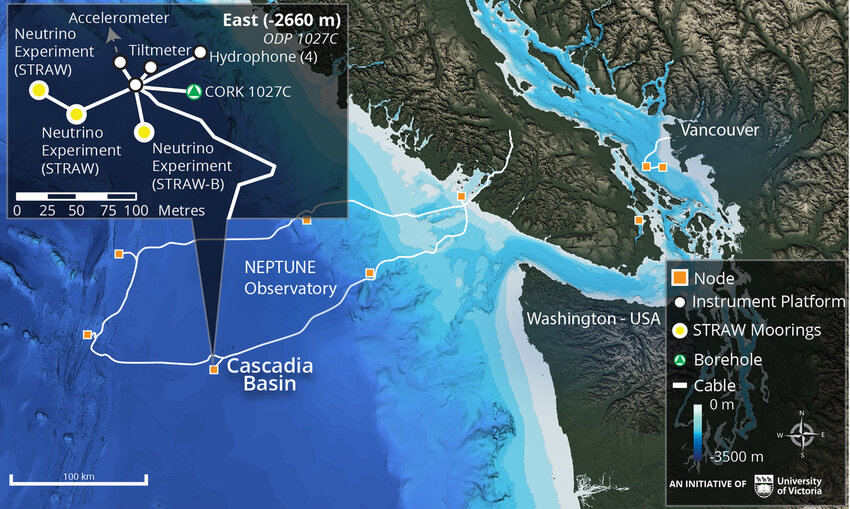
NEPTUNE Observatory
Map of the NEPTUNE Observatory operated by Ocean Networks Canada in the Pacific Ocean close to the west coast of Canada. The P-ONE detector will be located at the Cascada Basin node, a flat abyssal plane, where it will be connected to existing deep-sea infrastructure. Credit: Holzapfel et al, STRAW-b JINST 19 P05072 (2024) . © 2024 Ocean Networks Canada. All rights reserved.

For more information, contact us or visit the official P-ONE website at: https://www.pacific-neutrino.org/

Erlangen Centre for Astroparticle Physics (ECAP)
Friedrich-Alexander-Universität Erlangen-Nürnberg

Nikolaus-Fiebiger-Str. 2
91058 Erlangen
  • Contact
  • Imprint
  • Privacy
  • Accessibility
  • Internal
  • Facebook
  • Instagram
  • RSS Feed
Up