• Skip navigation
  • Skip to navigation
  • Skip to the bottom
Simulate organization breadcrumb open Simulate organization breadcrumb close
Erlangen Centre for Astroparticle Physics
  • FAUTo the central FAU website
  • Department of Physics
  • Dr. Karl Remeis Observatory

Erlangen Centre for Astroparticle Physics

Navigation Navigation close
  • Institute
    • Organisation and Code of Conduct
    • Research groups
      • Astronomy (Prof. Heber, Prof. Sasaki, Prof. Wilms)
      • Astroparticle Physics (Prof. Katz, Prof. van Eldik)
      • High-Energy Astrophysics (Prof. Funk)
      • Experimental Astroparticle Physics – Radiodetection of Neutrinos (Prof. Nelles)
      • Experimental Astroparticle Physics (Prof. Kopper)
      • Quantum Gravity (Prof. Thiemann, Prof. Giesel, Prof. Sahlmann)
      • Statistical Physics (Prof. Mecke)
    • ECAP Members
    • Vacancies
    • Thesis Topics
    • Infrastructure
    • Contact
    Portal Institute
  • Research
    • Publications
      • Articles and Proceedings
      • Theses
    • Astronomy and Astrophysics
    • Gamma-Ray Astronomy
    • Technology Transfer
    • Neutrino Astronomy
    • Neutrino Physics
    • Theory
      • Mathematical and Statistical Physics
      • Quantum Gravity
    • Cross-boundary Research Projects
    • Additional Research Areas
    Portal Research
  • Teaching
    • Current Lectures
    • School for Astroparticle Physics (ext.)
    • Erlanger SchülerForschungsZentrum (ext.)
    • Particle Physics Masterclasses (ext.)
    Portal Teaching
  • News and Events
    • News
    • Events
    • Seminar
    • ECAP-Shop
    • Outreach
    Portal News and Events
  • Thesis Topics
  1. Home
  2. Research
  3. Technology Transfer
  4. Laboratory Astrophysics

Laboratory Astrophysics

In page navigation: Research
  • Gamma-Ray Astronomy
    • CTA
    • Fermi-LAT
    • H.E.S.S.
  • Publications
    • Articles and Proceedings
    • Theses
  • Neutrino Astronomy
    • ANTARES | KM3NeT
    • IceCube
    • Radio Detection
  • Astronomy and Astrophysics
  • Neutrino Physics
    • KM3NeT – ORCA
  • Theory
    • Mathematical and Statistical Physics
    • Quantum Gravity
      • Research in Loop Quantum Gravity
  • Technology Transfer
    • Medical Physics
    • Materials Testing
    • Laboratory Astrophysics
  • Additional Research Areas
    • Acoustic Particle Detection
    • Hadron Physics
    • EXO-200
    • nEXO
  • Cross-boundary Research Projects
    • ECAP AI Laboratory

Laboratory Astrophysics

Laboratory Astrophysics

Prof. Dr. Gisela Anton

Physikalisches Institut
Lehrstuhl für Experimentelle Astroteilchenphysik (Prof. Dr. Kopper)

Room: Room 02.034
Nikolaus-Fiebiger-Str. 2
91058 Erlangen
  • Phone number: +49 9131 85-70737
  • Email: gisela.anton@physik.uni-erlangen.de
  • Website: https://ecap.nat.fau.de/index.php/person/prof-anton/
Prof. Dr. Stefan Funk

Prof. Dr. Stefan Funk

Physikalisches Institut
Chair of Physics

Room: Room 02.036
Nikolaus-Fiebiger-Str. 2
91058 Erlangen
  • Phone number: +49 9131 85-70727
  • Email: s.funk@fau.de
  • Website: https://ecap.nat.fau.de/index.php/person/prof-dr-stefan-funk/

Our group is engaged in different imaging tools for electron density retrieval in the X-ray regime at poly- as well as monochromatic sources. We are looking for potential applications of X-ray phase-contrast and dark-field imaging on plasma physics especially with regard to the field of laboratory astrophysics (see e.g. testing of shock waves in the laboratory, Figure 1). In collaboration with plasma physics groups the developed imaging tools can be tested at real and simulated plasmas. We aim at the observation and the analysis of dynamic processes of laser-shocked plasmas.
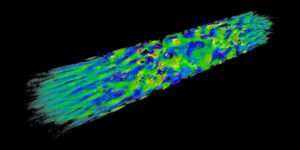
Figure 1: Computer simulations of the turbulent structure of the magnetic field in counter streaming shock waves (Credit: Frederico Fiuza/SLAC National Accelerator Laboratory)

Recently, we investigated the propagation of homogenisaion in foams of very low density. The process was detectable only by the X-ray dark-field image which lead to a measurable signal caused by the microstructure of the foam (Figure 2). The homogenisation disturbs this structure which leads to a measurable decrease in the dark-field signal.
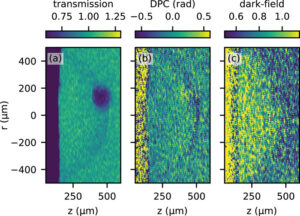
Figure 2: Low-density foam shown in (a) transmission, (b) differential phase-contrast, and (c) dark-field image. The dark spot in the transmission image is a sapphire bead. The foam half sphere itself is visible in the dark-field (From Ref. L. Wegert et al., Demonstrating grating-based phase-contrast imaging of laser-driven shock waves, 2024, Matter Radiat. Extremes, Vol. 9, No. 4. DOI: 10.1063/5.0200440; used under Creative Commons CC-BY 4.0 license).

Publications:

  • L. Wegert et al., 2024, Matter Radiat. Extremes, Vol. 9, No. 4 (https://doi.org/10.1063/5.0200440)
  • A. Wolf et al, 2022 J. Synchrotron Rad., 29, 794-806 (https://doi.org/10.1107/S160057752200193X)
  • S. Schreiner et al, 2021, J. Imaging 2021, 7(9), 178 (https://doi.org/10.3390/jimaging70901781)
  • B. Akstaller et al, 2021 JINST 16 P06021(https://iopscience.iop.org/article/10.1088/1748-0221/16/06/P06021)
  • A. Wolf et al, 2020, Opt. Express 28, 13553-13568 (https://www.osapublishing.org/oe/abstract.cfm?uri=oe-28-9-13553)
  • M. Seifert et al, 2020, J. Imaging 6(7) 63 (https://www.mdpi.com/2313-433X/6/7/63/htm)
  • M. Schuster et al, 2019, JINST 14 P08003 (https://iopscience.iop.org/article/10.1088/1748-0221/14/08/P08003/meta)
Erlangen Centre for Astroparticle Physics (ECAP)
Friedrich-Alexander-Universität Erlangen-Nürnberg

Nikolaus-Fiebiger-Str. 2
91058 Erlangen
  • Contact
  • Imprint
  • Privacy
  • Accessibility
  • Internal
  • Facebook
  • Instagram
  • RSS Feed
Up