
• ECAP Seminar: Kendall Mahn, Michigan State University

    ECAP Laboratory, 00.061 Nikolaus-Fiebiger-Str. 2, Erlangen, Germany

    You’re sending particles across a country? The Tokai to Kamioka experiment Neutrinos are a tiny subatomic particle with surprising properties under active study. In particular, neutrinos oscillate, that is, they convert from one type of neutrino to another, is a surprising phenomenon under active study. The origin of neutrino mass is important for astrophysics, cosmology […]
  • ECAP Seminar: Milena Crnogorcevic, Stockholm University

    ECAP Laboratory, 00.061 Nikolaus-Fiebiger-Str. 2, Erlangen, Germany

    Gamma Rays from the Littlest Galaxies: Tracing Accretion and Dark Matter in the Low-Mass Universe Now in its 17th year of operation, the Fermi Large Area Telescope (LAT) continues to transform our understanding of the smallest galaxies in the Universe. Dwarf galaxies host some of the most extreme environments known---from ultra-faint systems dominated by dark matter to […]

  • ECAP Seminar: Lucas de Sa, Heidelberg University

    ECAP Laboratory, 00.061 Nikolaus-Fiebiger-Str. 2, Erlangen, Germany

    Prospects for pulsars and pulsar associations in multi-messenger astrophysics with population synthesis Population synthesis seeks to integrate the full framework of stellar evolution with predictions for observations of different products of said evolution, potentially allowing constraints to be placed on multiple evolutionary steps at the same time. It has become a central tool in gravitational-wave astronomy […]

  • DPG Spring Meeting at FAU

    Philosophie, Kollegienhaus and Alte Mathemathik, Erlangen Universitätsstr. 15, Erlangen, Germany

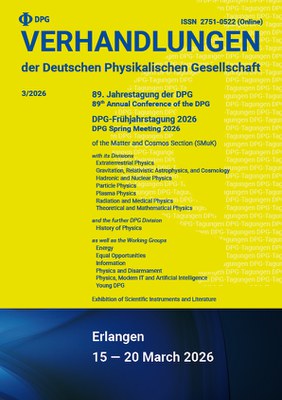
    ECAP is happy to organise the 89 Annual Conference of the DPG and DPG Spring Meeting of the Matter and Cosmos Section (SMuK) 15 - 20 March 2026 We expect around 2000 physicists to join this conference downtown Erlangen. More information at https://erlangen26.dpg-tagungen.de

  • ECAP Seminar: Matthias Danninger, Simon Fraser University

    ECAP Laboratory, 00.061 Nikolaus-Fiebiger-Str. 2, Erlangen, Germany

    The Pacific Ocean Neutrino Experiment Every time researchers have pushed the energy boundary in particle physics we have found something new about our Universe. Recently, IceCube has demonstrated that Neutrino Telescopes can use neutrinos from the cosmos as excellent tools to continue this exploration. To unlock the true potential of this field, advanced detectors are […]

  • ECAP Seminar: Tanguy Pierog, KIT

    ECAP Laboratory, 00.061 Nikolaus-Fiebiger-Str. 2, Erlangen, Germany

    EPOS LHC-R : a global approach to solve the muon puzzle The hadron production in the simulation of extensive air showers is a long standing problem and the origin of large uncertainties in the reconstruction of the mass of the high energy primary cosmic rays. Hadronic interaction models re-tuned after early LHC data give more […]

  • ECAP Seminar: Ernst-Jan Buis, Nikhef

    ECAP Laboratory, 00.061 Nikolaus-Fiebiger-Str. 2, Erlangen, Germany

    Fiber optic hydrophones for acoustic neutrino detection The scientific potential for detecting cosmic neutrinos with energies at or above the GZK cut-off—the energy limit for cosmic rays due to interactions with the cosmic microwave background—has been extensively discussed in the literature. The recent observation of a very high-energy event by the KM3NeT telescope has further […]

  • ECAP Seminar: Kavitha Arur, University of Maryland / NASA

    ECAP Laboratory, 00.061 Nikolaus-Fiebiger-Str. 2, Erlangen, Germany

    Introduction to and Science highlights from the Imaging X-ray Polarimetry Explorer The Imaging X-ray Polarimetry Explorer (IXPE) is a NASA Small Explorer Mission resulting from the collaboration of NASA Marshall Space Flight Center, the Italian Space Agency and other partners. IXPE has been successfully performing science operations since January 2022. IXPE provides unique and powerful […]

  • ECAP Seminar: Philipp Eller, Technical University Munich

    ECAP Laboratory, 00.061 Nikolaus-Fiebiger-Str. 2, Erlangen, Germany

    Newtrinos.jl — An Open-Source, Community-Driven Global Fit for Neutrino Physics Global fits — combined analyses of datasets from multiple experiments — have long been central to neutrino physics, given the field's rich and diverse experimental landscape. To date, these efforts have been carried out by a small number of groups, each relying on closed-source, proprietary […]

  • ECAP Seminar: Tim Huege, KIT

    SRTL 307 Erwin-Rommel-Straße 1, Erlangen, Germany

    Radio detection of cosmic particles: the Pierre Auger Observatory, the Square Kilometre Array, and CORSIKA 8 Over the last 20 years, radio detection of cosmic particles has developed from small-scale prototype experiments to precision measurements employing thousands to tens of thousands of antennas. We have long left the phase of studying the radio detection technique […]

  • ECAP Seminar: Julia Herzen, TUM

    ECAP Laboratory, 00.061 Nikolaus-Fiebiger-Str. 2, Erlangen, Germany

    Quantitative x-ray imaging – towards material-specific numbers from images Conventional X-ray imaging has relied on attenuation contrast for more than a century, limiting the visualization and characterization of soft tissues. Phase-contrast and dark-field X-ray imaging exploit X- ray refraction and small-angle scattering to provide complementary information, offering improved soft- tissue contrast and sensitivity to microstructural […]