• Skip navigation
  • Skip to navigation
  • Skip to the bottom
Simulate organization breadcrumb open Simulate organization breadcrumb close
Erlangen Centre for Astroparticle Physics
  • FAUTo the central FAU website
  • Department of Physics
  • Dr. Karl Remeis Observatory

Erlangen Centre for Astroparticle Physics

Navigation Navigation close
  • Institute
    • Organisation and Code of Conduct
    • Research groups
      • Astronomy (Prof. Heber, Prof. Sasaki, Prof. Wilms)
      • Astroparticle Physics (Prof. Katz, Prof. van Eldik)
      • High-Energy Astrophysics (Prof. Funk)
      • Experimental Astroparticle Physics – Radiodetection of Neutrinos (Prof. Nelles)
      • Experimental Astroparticle Physics (Prof. Kopper)
      • Quantum Gravity (Prof. Thiemann, Prof. Giesel, Prof. Sahlmann)
      • Statistical Physics (Prof. Mecke)
    • ECAP Members
    • Vacancies
    • Thesis Topics
    • Infrastructure
    • Contact
    Portal Institute
  • Research
    • Publications
      • Articles and Proceedings
      • Theses
    • Astronomy and Astrophysics
    • Gamma-Ray Astronomy
    • Technology Transfer
    • Neutrino Astronomy
    • Neutrino Physics
    • Theory
      • Mathematical and Statistical Physics
      • Quantum Gravity
    • Cross-boundary Research Projects
    • Additional Research Areas
    Portal Research
  • Teaching
    • Current Lectures
    • School for Astroparticle Physics (ext.)
    • Erlanger SchülerForschungsZentrum (ext.)
    • Particle Physics Masterclasses (ext.)
    Portal Teaching
  • News and Events
    • News
    • Events
    • Seminar
    • ECAP-Shop
    • Outreach
    Portal News and Events
  • Thesis Topics
  1. Home
  2. Research
  3. Additional Research Areas
  4. nEXO

nEXO

In page navigation: Research
  • Gamma-Ray Astronomy
    • CTA
    • Fermi-LAT
    • H.E.S.S.
  • Publications
    • Articles and Proceedings
    • Theses
  • Neutrino Astronomy
    • ANTARES | KM3NeT
    • IceCube
    • Radio Detection
  • Astronomy and Astrophysics
  • Neutrino Physics
    • KM3NeT – ORCA
  • Theory
    • Mathematical and Statistical Physics
    • Quantum Gravity
      • Research in Loop Quantum Gravity
  • Technology Transfer
    • Medical Physics
    • Materials Testing
    • Laboratory Astrophysics
  • Additional Research Areas
    • Acoustic Particle Detection
    • Hadron Physics
    • EXO-200
    • nEXO
  • Cross-boundary Research Projects
    • ECAP AI Laboratory

nEXO

PD Dr. Thilo Michel

The nEXO experiment

nEXO is a collaboration of 28 universities and institutes in 7 countries over 3 continents which intends to search for the neutrinoless double beta decay of 136Xe. A link to the homepage can be found here.
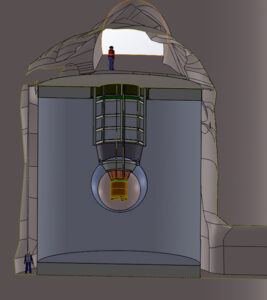
Artist’s view of nEXO at the SNOlab underground laboratory.

Compared to the predecessor EXO-200, where 200 kg of liquid Xenon were used, nEXO is a large scale experiment with a total xenon mass of about 5 tons enriched to ≈ 90% of 136Xe. The detector will be a cylinder 1.3 m in diameter and the lateral surface will be covered with Silicon photomultipliers (SiPM). These SiPMs detect the scintillation light of the xenon atoms that were excited by the electrons emitted in a possible 0νββ-decay event. At the bottom of the cylinder, a panel of anodes will collect the secondary electrons which are also produced in such events and are drifted to the anode by strong electrical fields in the cylinder. Both signal channels allow an accurate measurement of the event energy, with an energy resolution of about 1% (σ) or less at the total decay energy (Q-value). The whole setup works as a time-projection-chamber, where the charge (x-y position) and the light information (z position) is used to determine the three dimensional position of each event. Since the decay rate is very low, one needs exceptionally radiopure materials, ultra-pure xenon, very efficient scintillation light detection, low electronic noise, good energy resolution, operation deep underground and possibly the tagging of the daughter nucleus (136Ba). Further information on the neutrinoless double beta decay and the nEXO experiment can be found under the following links:

  • How does nEXO work?
  • In search for no neutrinos.


Erlangen Centre for Astroparticle Physics (ECAP)
Friedrich-Alexander-Universität Erlangen-Nürnberg

Nikolaus-Fiebiger-Str. 2
91058 Erlangen
  • Contact
  • Imprint
  • Privacy
  • Accessibility
  • Internal
  • Facebook
  • Instagram
  • RSS Feed
Up