
• ECAP Seminar: Oliver Friedrich, LMU Sternwarte

    ECAP Laboratory, 00.061 Nikolaus-Fiebiger-Str. 2, Erlangen, Germany

    Forcing neutrinos to obey the holographic principle Gravity does not like the vast amounts of states present in QFT, and quantum gravitational effects are expected to drastically reduce the dimension […]
  • ECAP Seminar: Philipp Windischhofer, U Chicago

    Physikum, Hörsaal HF Staudtstr. 5, Erlangen, Germany

    Exploring the Universe at the Highest Energies: when Particle Physics and Astronomy meet High-energy neutrinos propagating over cosmological distances are the ideal messenger particles for astrophysical phenomena, but the neutrino […]

  • ECAP Seminar: Benedikt Bergmann, IEAP/CTU, Prague

    ECAP Laboratory, 00.061 Nikolaus-Fiebiger-Str. 2, Erlangen, Germany

    Particle tracking and identification with Timepix-series detector setups in nuclear, particle and astrophysics In high energy physics experiments, hybrid pixel detectors are an integral part of the tracking systems closest […]

  • ECAP Seminar: Branden Allen, University of Hawaii

    ECAP Laboratory, 00.061 Nikolaus-Fiebiger-Str. 2, Erlangen, Germany

    Introduction to the Space Science and Engineering Initiative, and Opportunities and Applications for the Next Generation of X and gamma-ray Detector Systems and Technologies The Space Science and Engineering Initiative […]

  • ECAP Seminar: Mauricio Bustamante

    ECAP Laboratory, 00.061 Nikolaus-Fiebiger-Str. 2, Erlangen, Germany

    Fundamental physics with high-energy and ultra-high-energy cosmic neutrinos High-energy cosmic neutrinos probe fundamental physics at scales of energy and distance otherwise unreachable, where new physics may manifest. Since the discovery […]

  • ECAP Seminar: Kendall Mahn, Michigan State University

    ECAP Laboratory, 00.061 Nikolaus-Fiebiger-Str. 2, Erlangen, Germany

    You’re sending particles across a country? The Tokai to Kamioka experiment Neutrinos are a tiny subatomic particle with surprising properties under active study. In particular, neutrinos oscillate, that is, they […]

  • ECAP Seminar: Milena Crnogorcevic, Stockholm University

    ECAP Laboratory, 00.061 Nikolaus-Fiebiger-Str. 2, Erlangen, Germany

    Gamma Rays from the Littlest Galaxies: Tracing Accretion and Dark Matter in the Low-Mass Universe Now in its 17th year of operation, the Fermi Large Area Telescope (LAT) continues to transform our […]

  • ECAP Seminar: Lucas de Sa, Heidelberg University

    ECAP Laboratory, 00.061 Nikolaus-Fiebiger-Str. 2, Erlangen, Germany

    Prospects for pulsars and pulsar associations in multi-messenger astrophysics with population synthesis Population synthesis seeks to integrate the full framework of stellar evolution with predictions for observations of different products […]

  • DPG Spring Meeting at FAU

    Philosophie, Kollegienhaus and Alte Mathemathik, Erlangen Universitätsstr. 15, Erlangen, Germany

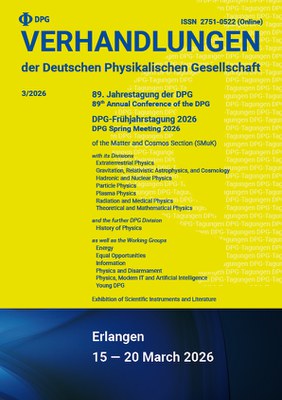
    ECAP is happy to organise the 89 Annual Conference of the DPG and DPG Spring Meeting of the Matter and Cosmos Section (SMuK) 15 - 20 March 2026 We expect […]

  • ECAP Seminar: Matthias Danninger, Simon Fraser University

    ECAP Laboratory, 00.061 Nikolaus-Fiebiger-Str. 2, Erlangen, Germany

    The Pacific Ocean Neutrino Experiment Every time researchers have pushed the energy boundary in particle physics we have found something new about our Universe. Recently, IceCube has demonstrated that Neutrino […]

  • ECAP Seminar: Tanguy Pierog, KIT

    ECAP Laboratory, 00.061 Nikolaus-Fiebiger-Str. 2, Erlangen, Germany

    EPOS LHC-R : a global approach to solve the muon puzzle The hadron production in the simulation of extensive air showers is a long standing problem and the origin of […]

  • ECAP Seminar: Ernst-Jan Buis, Nikhef

    ECAP Laboratory, 00.061 Nikolaus-Fiebiger-Str. 2, Erlangen, Germany

    Fiber optic hydrophones for acoustic neutrino detection The scientific potential for detecting cosmic neutrinos with energies at or above the GZK cut-off—the energy limit for cosmic rays due to interactions […]